
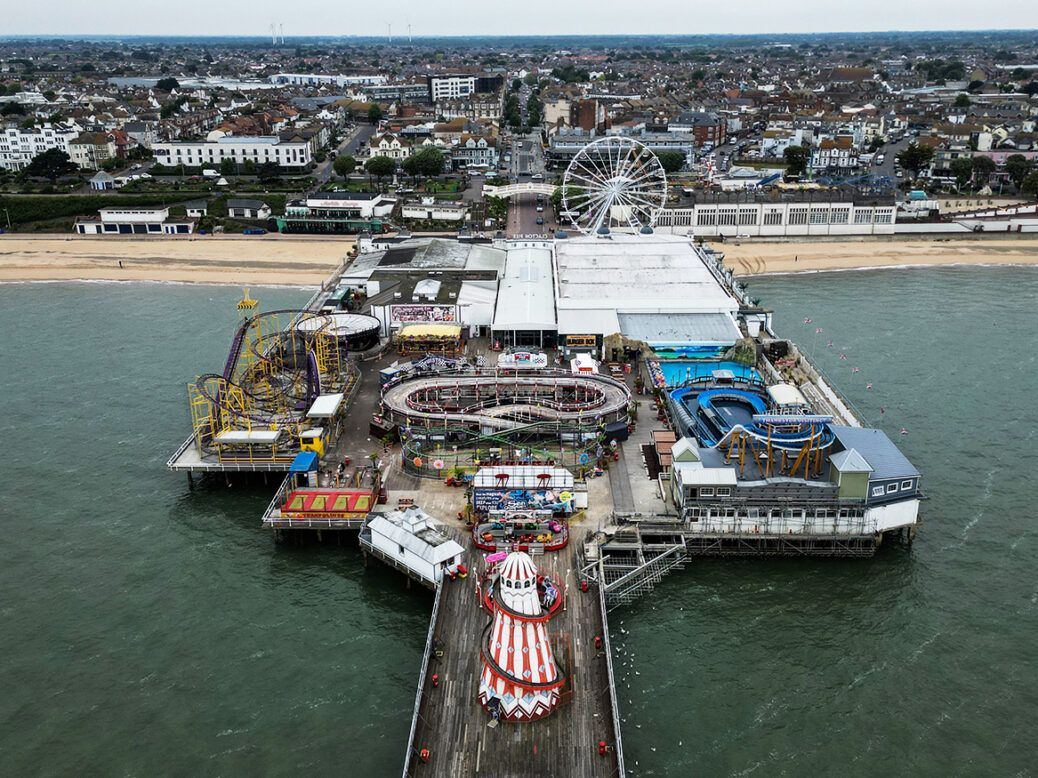
At the entrance to Clacton Pier, beneath the slowly spinning big wheel, is the Tubby Isaacs seafood stand. Shaded by its scarlet awning lie cockles, whelks and jellied eels: a portal to an old East End on the Essex coast. One of its servers, who rides into work on a cherry-red scooter emblazoned with a Union Jack every morning, told me she would be voting for Reform in the local elections.
There was no nostalgic lament for a lost England, nothing against asylum seekers, no rant about inflation or business rates. Her one preoccupation was with potholes. “If I hit one of those, I’m coming off my scooter. It’s dangerous, and it’s got so much worse – it’s disgusting,” she told me. “The council should be taking care of them. The other two parties have done nothing, so hopefully Reform can. Otherwise I’m thinking about moving country.”
What else was on her mind when we spoke a few days before the polls opened, in the heart of Farage country? Nothing, she said. The state of the roads was reason enough to kick out the Conservative-led Essex County Council, and make way for Reform, the insurgent party of her local MP, Nigel Farage. She wasn’t alone. Roads – including parking, potholes and congestion – topped YouGov’s list of voter concerns ahead of polling day this year, even coming above the cost of living.
I don’t highlight this as a twee localist plea for more pavement politics; I know from years of local election reporting that national issues very much play into voters’ choices even when they’re only deciding on the make-up of their council, and that was no different this time around. But what has become increasingly clear is that the council administering your local services can no longer be separated from your politics. Almost every plotline in the narrative of Britain’s malaise, on both left and right, among the apolitical and hyper-online, can be traced back to local government. Housing, high streets, rising bills, planning, the NHS, crime and antisocial behaviour, asylum hotels, HMOs, bin strikes, potholes… All are symptoms or side effects of broken councils.

The reason potholes go unfilled – to the point where residents are even holding mock first-birthday parties for their anniversaries, and floating rubber ducks in them when it rains – is that instead of regular resurfacing, councils patch up roads and leave them to decline. This is because they don’t have the stable, year-on-year revenue for regular maintenance, and they can’t borrow to fund day-to-day spending. They don’t have enough cash as a consequence of government grants drying up 16 years ago, when the coalition began its austerity drive. Central funding for local authorities was cut by more than 40 per cent in real terms in the decade after 2010.
David Cameron and George Osborne’s stated intention was to make local authorities leaner, more efficient, for the “Big Society” of civic life to step in where public service retreated. They left councils to decide between what has been described by one MP to me as “EasyCouncil” – outsourcing basic duties to private firms – and simply doing less. Council tax had to rise to make up for the fall in funding. All the while, demand for the main service councils must legally provide, social care, has risen sharply, driven by both an ageing population and working-age sick and disabled people living longer. With further statutory duties to house homeless people in temporary accommodation and supply special educational needs support, there has been less and less money to spend on things in between – everything we presume our council tax should be spent on.
All of this is why councils have little resource to crack down on problem HMOs or dodgy high-street vendors, pay bin collectors properly, keep on top of pest control, hold property developers to their promises to fund local amenities, or maintain roads, playgrounds and parks. It’s why they’re dimming streetlights, closing pools and being gazumped by private Home Office contractors who rent accommodation out to asylum seekers. And it’s why so many voters are exasperated by their shoddy high roads; believe asylum seekers are prioritised above locals for housing; feel ripped off when fined for driving within a low-traffic neighbourhood; and despair at NHS waiting times (unmet demand for social care, a council duty, keeps people stuck waiting in hospital beds who shouldn’t be). These are all concerns that find their way to the flaking front door of the town hall, if it hasn’t already been sold off. And this is all while most voters have watched their council tax bills rise.
Reform has discovered this reality, when taking control of a number of councils around the country – having no choice but to raise council tax after promising not to, and even writing to the Home Secretary to beg her not to limit visas for migrant care workers, which would make social care more expensive to provide. And outsourcing is one of the reasons the once-Green heartland of Brighton has had one of England’s lowest recycling rates.
Local elections, then, are about local issues, even as residents imagine the national picture when they enter the polling booth. But without major reform of some of the trickiest parts of the state – social care, council tax and business rates – whichever party they vote in has little chance of escaping the Town Hall Theory of Everything.
[Further reading: Young, down and out of work]
Content from our partners

Related


This article appears in the 06 May 2026 issue of the New Statesman, Tis but a scratch
Join the debate
Subscribe here to comment